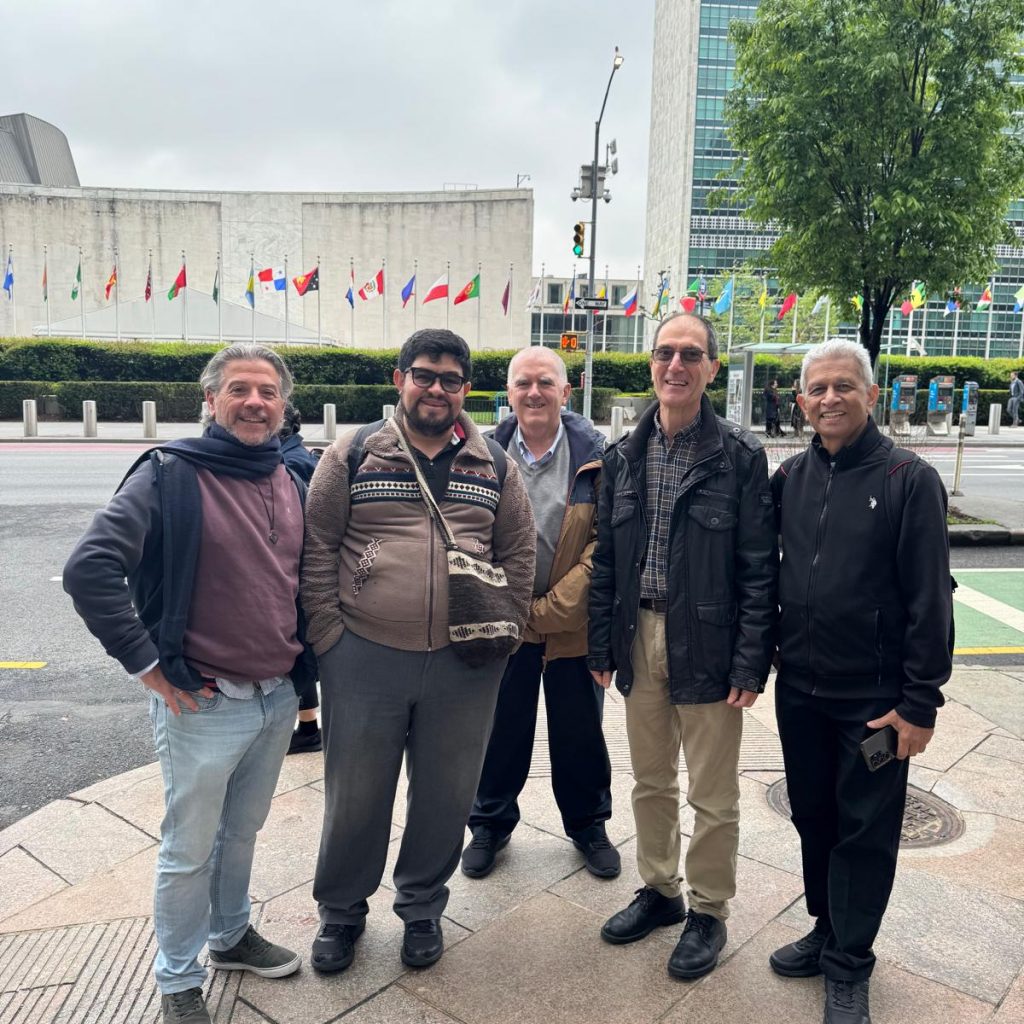


Taking part in the International Forum on Migration Review at the United Nations headquarters, as part of the PROCLADE Internazionale delegation, has been a deeply enriching and eye-opening experience. Rather than merely representing an institutional presence, I discovered a space where the Gospel can make its voice heard amidst the major decisions that affect the lives of millions of people.
This experience has helped me to understand that mission also takes place where the fate of peoples is decided, where migration policies, human rights, sustainable development and responses to the climate crisis are debated. Being present at the UN means bringing the reality of the peripheries into spaces where political and economic discourse usually predominates.
The presence of the Claretians in these international bodies does not replace the daily mission we live out in our communities and projects; on the contrary, it extends, articulates and amplifies it. It is a concrete way of making visible the cry of so many migrants and vulnerable people whom we accompany every day.
At the same time, this experience presents me with a significant challenge: to present and make people feel that the presence of the Claretian missionaries at the UN is truly our own. To understand that when the Claretian Family participates in the UN, it is not just an organisation speaking, but also our communities, our struggles and our shared hope for a more humane, just and fraternal world.
The most significant themes that have emerged in the panels I have participated in, the parallel forums, multi-sectoral hearings and statements by social organisations have been:
- Regularisation and safe migration routes.
Many organisations are calling for comprehensive regularisation programmes, access to documentation and the opening of legal and safe migration routes, in the face of increasing restrictive policies and the externalisation of borders.
- Criminalisation of migrants and of solidarity.
There are strong complaints regarding the persecution of young people accused of ‘trafficking’ for piloting boats, the criminalisation of rescue NGOs, and the growing preference for security-based approaches over human rights-based approaches.
Concerns have been raised that state security is taking precedence over the protection of life and human dignity.
- Labour rights and decent work.
Trade unions and social organisations are insisting on: living wages, an end to labour exploitation, the elimination of excessive fees for obtaining
documentation, access to labour justice, and universal social protection for migrant workers.
- Universal access to healthcare, education and basic services
One of the key panels addressed specifically migrant health and access to essential services without discrimination, regardless of migration status.
- Combating racism, xenophobia and hate speech
Civil society is warning of the rise of institutional and political racism in various regions of the world and is calling for inclusive policies that promote social cohesion and equal rights.
- Migration and climate change
Various initiatives are linking human mobility to the climate crisis, environmental justice and a just ecological transition, particularly in countries of the Global South.
- Genuine participation of migrants in decision-making
A key demand is that migrants should not merely be ‘beneficiaries’ but active participants in the development of public policies and in United Nations debates.
- Feminist perspective and the role of migrant women
The contribution of migrant women to care work, community support and global economies is highlighted, whilst also denouncing the multiple forms of violence and precariousness they face.
- Defending the Global Compact for Migration in the face of setbacks
Many speakers have pointed out that, despite the commitment to the Global Compact for Safe, Orderly and Regular Migration, several states are rolling back rights and prioritising policies of containment and deportation.
- Migration as a contribution, not a threat
There is a strong call to change the dominant narrative: migration is presented as a human right and as a fundamental social, economic, cultural and demographic contribution to host societies.
Fr. José Antonio Benítez Pineda, cmf